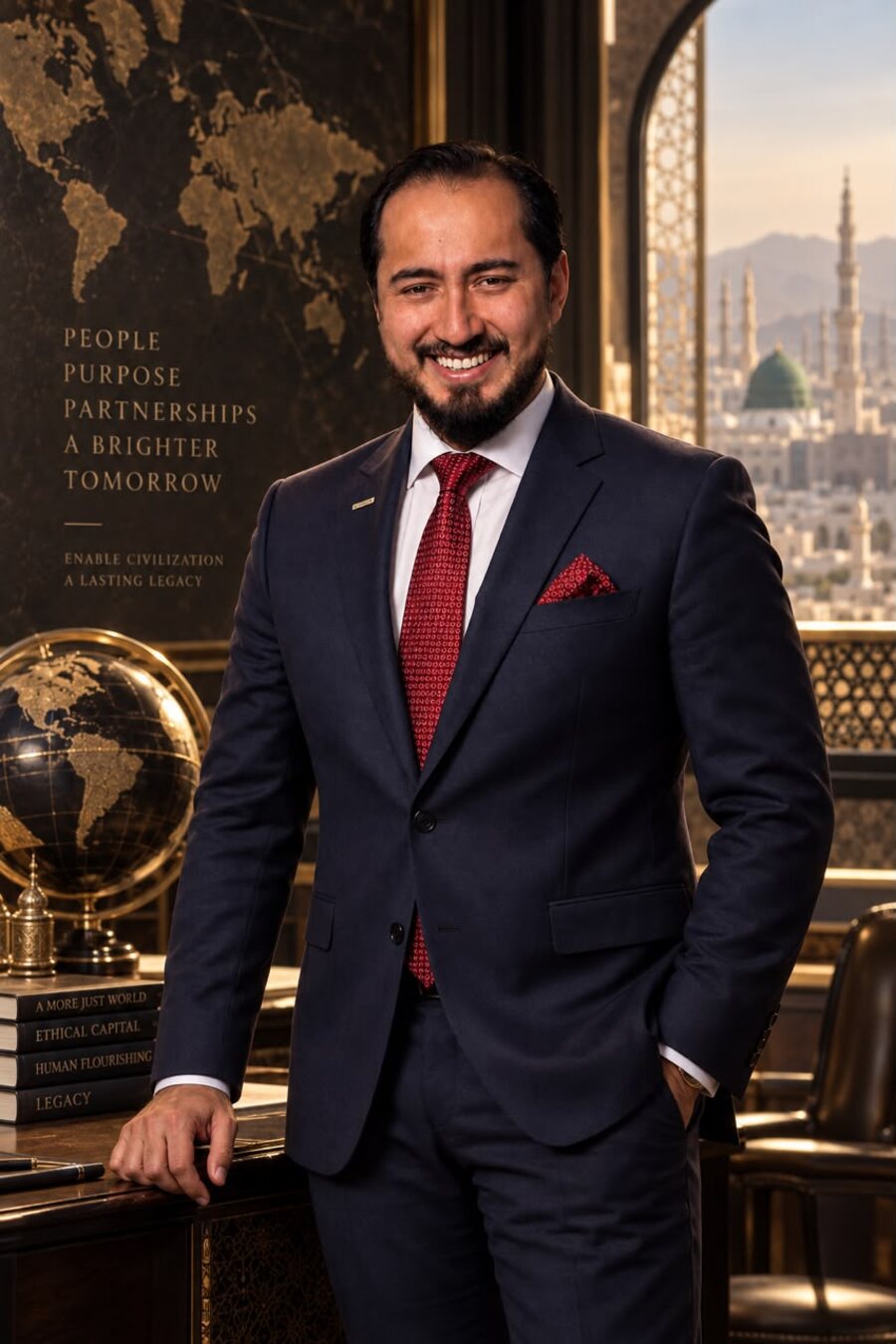
From the founder
A note from the founder.
Muhammad Izzuddin IliyesFounder, Haramain Legacy
What is the highest use of what has been entrusted to us?
For more than thirteen years, I have worked around zakat, philanthropy and Islamic social finance. During that time, I have had the privilege of standing between two worlds: people entrusted with capital, and people and institutions trying to solve difficult human problems.
Over time, I began to see a contradiction. There is no shortage of human need. And there is certainly no shortage of capital. Yet too often, the two fail to meet effectively.
I saw capital owners who genuinely wanted to contribute but did not know where to deploy their resources or whom they could trust. I saw weaknesses in governance, transparency and impact measurement that made this hesitation understandable. At the same time, I saw generous philanthropy being deployed without sufficient strategy. Money was distributed, but the question was not always asked clearly enough: what actually changed because this capital was deployed?
The result can become a vicious cycle. Weak governance creates weak trust. Weak trust reduces capital deployment. Institutions remain under-resourced and underdeveloped. And capital that could have addressed meaningful human and environmental challenges remains undeployed.
Ethical Capital was born from a belief that there must be a better way.
Capital should not merely compound wealth. It should contribute to human and environmental flourishing.
I also began questioning something deeper: how we define the success of capital itself.
Modern finance has become extraordinarily sophisticated at measuring financial value — revenue, profit, valuation and return. These measures matter. I do not believe profit is inherently problematic. But they provide an incomplete accounting of what capital creates.
Two companies can produce exactly the same financial profit while leaving completely different footprints on humanity. One may create its earnings through innovation, fair treatment of employees, responsible relationships with suppliers and genuine value for customers. Another may produce identical earnings through exploitation, unfair pricing, environmental harm or extraction. Financially, the numbers may look similar. Ethically, they are not.
This is why I believe we must begin discussing not only the quantity of profit, but also its quality. I call this Ethical Profit. And it leads to a larger idea: Ethical Capital must examine not only why capital is deployed, but how it is deployed and what it ultimately causes. Intention. Conduct. Consequence.
This question becomes even more important as we enter the age of artificial intelligence. AI will increasingly make analysis, execution and optimisation faster, cheaper and more accessible. But the more powerful our tools become, the more important another question becomes: what should all this capability serve?
Technology can help us analyse needs, assess institutions, identify opportunities, match capital with impact and measure outcomes. But optimisation alone cannot decide what is worth pursuing. When execution becomes abundant, purpose becomes more important.
This has also caused me to reconsider our relationship with wealth. There is nothing inherently wrong with building wealth. Wealth provides security, protects families, enables entrepreneurship and allows institutions to be built. But accumulation cannot become its own destination.
Eventually, a person may reach a point of sufficiency: their family is provided for, their commitments are met and their desired lifestyle is sustainable. Beyond that lies an important question: what is the highest use of the surplus?
For me, this is where enoughness becomes liberating. Enoughness does not mean the end of ambition. A person can have enough for themselves while remaining extraordinarily ambitious about what their capital, enterprise and institutions can contribute to others.
We can reduce the expansion of consumption without reducing the expansion of contribution.
I believe many people who have built significant wealth eventually confront this question. They want their wealth to mean something. They want to know that what they have accumulated can become useful to humanity. Yet they need confidence that the capital will be deployed responsibly, governed properly and directed toward interventions that genuinely work.
That is the space Ethical Capital seeks to serve. We want to help capital owners understand where and how their surplus resources can contribute meaningfully. And on the other side, we want to work with high-impact founders and institutions to improve effectiveness, efficiency, governance, integrity and measurable impact. The objective is not simply to move more money. It is to deploy capital better.
My own conviction is ultimately quite simple: wealth is not merely something we own. It is something we are responsible for. I see wealth as an amānah — a trust and a responsibility. My faith teaches me to view this life within a horizon much larger than financial success alone. I therefore feel responsible for putting whatever experience, knowledge, relationships and opportunities I have been given to meaningful use.
I do not believe Ethical Capital alone will solve the world’s problems. But I believe that if more people who possess surplus wealth begin asking better questions about purpose, stewardship and impact — and if we build better institutions through which that capital can be deployed — the consequences could be extraordinary. Less capital sitting without purpose. Better institutions receiving it. Greater accountability. Greater trust. Greater human and environmental flourishing. And perhaps a different relationship with wealth itself.
Not: how much more can I accumulate? But: what becomes possible for others because I have more than enough?
How it works
The right capital. The right opportunity. The right fit.
Capital
HNWIs · Family Offices · Philanthropists · Impact Investors
Ethical Capital
Understand · Curate · Match · Connect
Impact
Founders · Institutions · Ventures · Transformative Projects
We understand both sides and connect the right capital with the right impact opportunity.
Human judgement comes first. The tools to support it are in development.
The gap this was built to close
There is a gap that is easy to describe and hard to close. People who hold capital and want it to do something worthwhile struggle to find opportunities they can trust. People building something worthwhile struggle to find capital that understands what they are actually doing.
Both sides are looking for each other. What separates them is not appetite. It is trust, diligence, and the fact that the relationships which would close the gap do not exist yet.
Ethical Capital and Haramain Legacy
Ethical Capital is a platform of Haramain Legacy, a group being built across capital, development, education, energy and technology. Each platform serves a different part of one purpose.
Ethical Capital is the first to open, because it is closest to the work its founder has already spent his career doing.
Background
The founder’s career has been in mobilising capital for social impact — working across philanthropy, zakāt, Islamic social finance and impact capital, and with the individuals, families and institutions who deploy it.
That work is the reason this platform begins with curation and relationships rather than with a marketplace. The problem was never a shortage of listings.
Track record
- 13+years across zakat, philanthropy and Islamic social finance, since 2013
- 1,000+clients served, with deep experience among high-net-worth individuals
- 8+relationship geographies — Malaysia, Indonesia, Brunei, Australia, New Zealand, Türkiye, Saudi Arabia and the UAE
Formation
- UWC Atlantic College — an international education built around service and difference.
- University of Nottingham — BA Economics, after beginning in mechanical engineering.
- A final-year thesis on trade liberalisation and poverty reduction.
- A long-standing interest in philosophy, economics and institution-building.
Where the relationships are
Meaningful relationships across Southeast Asia, the Gulf, East Asia and Australasia, alongside the global UWC community.
These are relationships and access, not offices. Haramain Legacy has no established institutional presence in these markets and does not claim one.
The values we work by
- Amānah — trust and responsibility for what is held on behalf of others.
- Iḥsān — excellence beyond the minimum required.
- Khidmah — service, and usefulness before self-display.
- Stewardship — long-horizon responsibility for capital and its consequences.

Join the Founding Network